1930 By the 1930s, a combination of increased demand for bricks and mechanization of the brickmaking process depleted the brickfields. The only brickyard left operating was Price’s yard at 395 Greenwood Avenue. It became the Toronto Brick Company and closed in the 1950s. Torbrick Road, though a housing project, sits on the site of the yard.[1] The derelict brickyards became subdivisions, schools and parks. Morley’s brickyard became Greenwood Park. The Wagstaff brickyard on Ashbridges’ Creek south of Felstead later was filled in and became Monarch Park. Felstead Park was also a brickyard. The playing field of St. Patrick Catholic Secondary School is also a rehabilitated quarry. Another Brickyard became first Harper’s Dump and then the Greenwood Subway Yards. Manufacturers used other brickyards for factories.[2]
[1] Myrvold, Barbara. The Danforth in Pictures: A Brief History of the Danforth. Toronto: Toronto Public Library, 1979, 17.
[2] Myrvold, Barbara. The Danforth in Pictures: Avenue Brief History of the Danforth. Toronto: Toronto Public Library, 1979, 17.


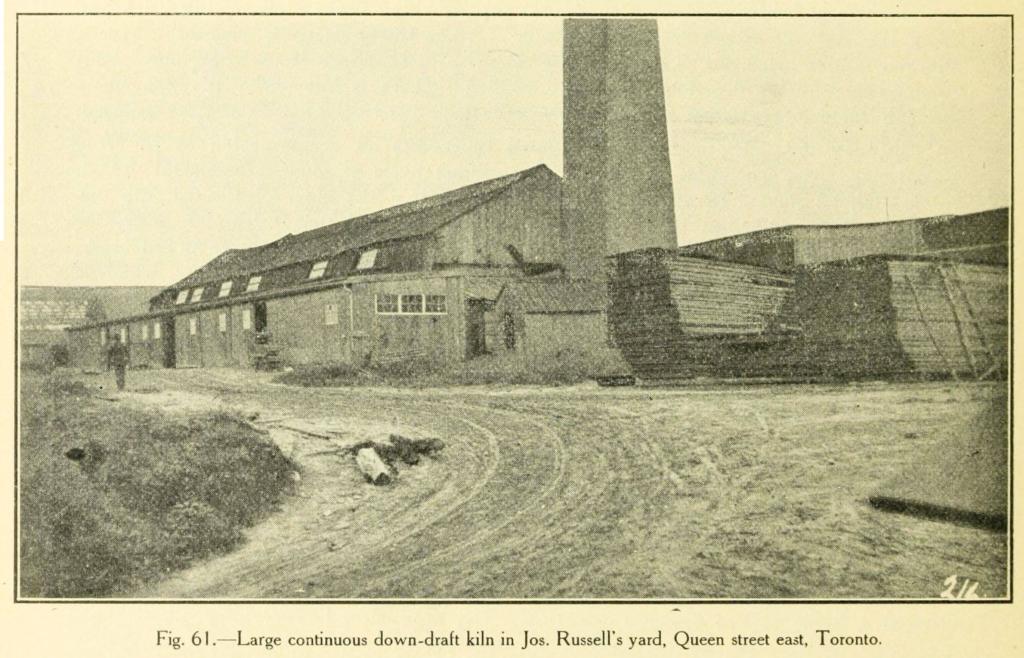
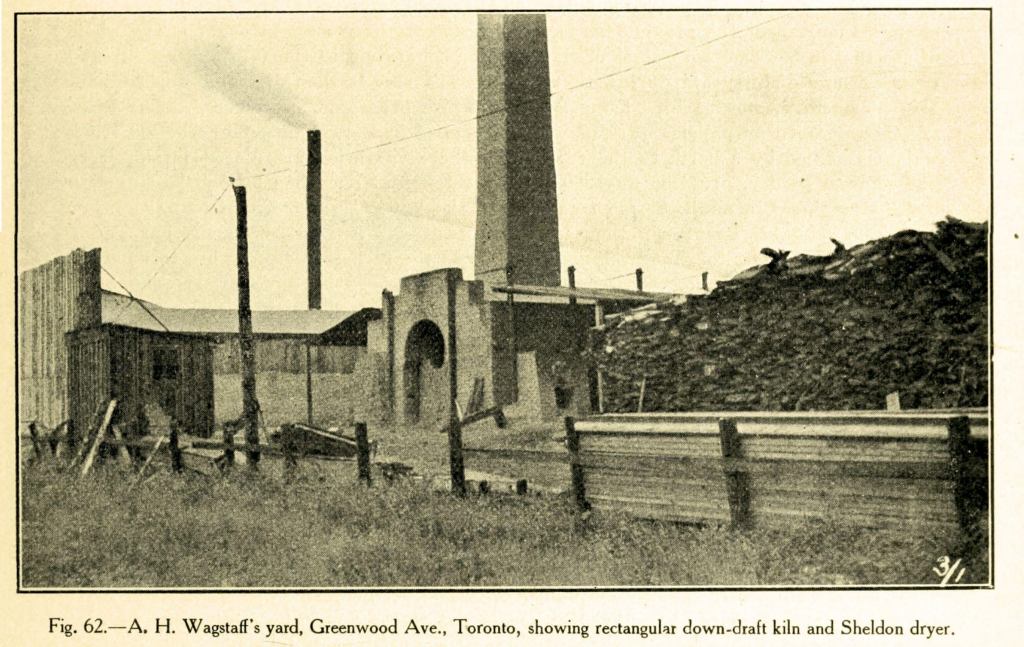
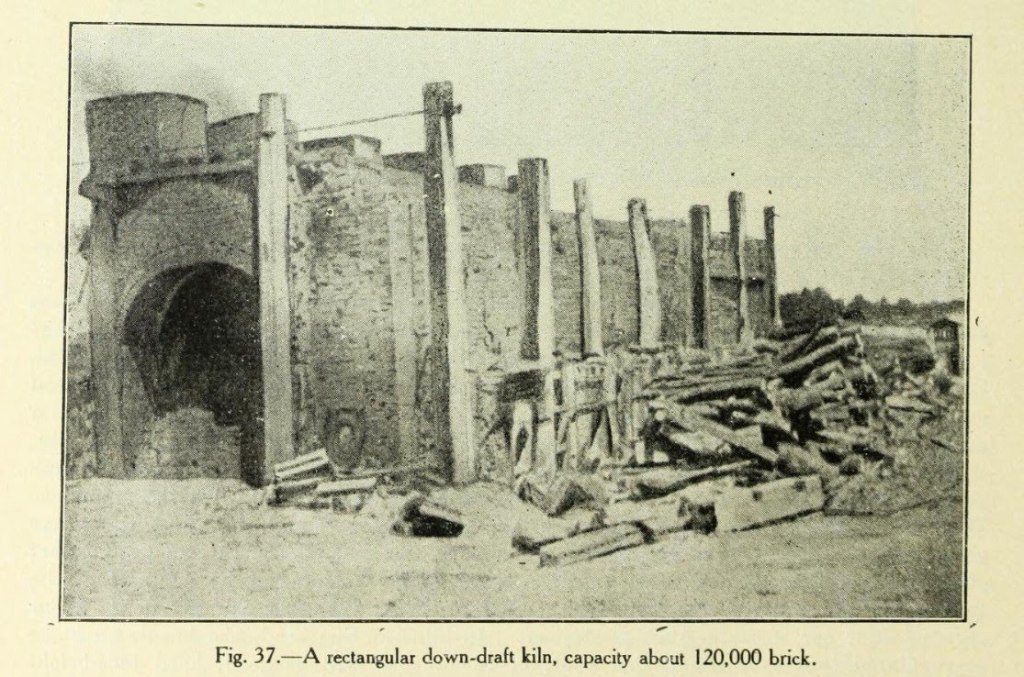
Professor Coleman on the clay deposits:
The extent of these deposits has not yet been worked out in detail, though the lower stratified clay was apparently widespread. Twenty feet of clay very like it, containing thin layers of peaty matter, may be seen on the shore of Lake Ontario four miles to the east of Highland Creek, here also covered by a bed of till. Exactly similar clay occurs about four miles to the northwest of Victoria Park in the brickyards of Messrs. Price and Logan. The exposures are excellent, one presenting a face of sixty feet; and the top of the clay, which rises about one hundred feet above Lake Ontario, is covered with a few feet of stratified sand. One finds the greenish plate-like concretions, and peaty matter containing mosses, pieces of bark and wood, elytra of beetles, flakes of mica, etc., just as at Scarboro’. The layer of till is wanting at these brickyards, but is found a few hundred yards farther north near the corner of Danforth avenue and Greenwood lane.
Coleman, A.P. Glacial and Inter-Glacial Deposits Near Toronto,Photograph. A.P. Coleman. Price’s Brickyard (Toronto). 1924 ROM Archives. A.P. Coleman Collection Reprinted from The Journal of Geology, Volume III
, Number 6 September-October, 1895. Chicago: The University of Chicago Press, p. 631.
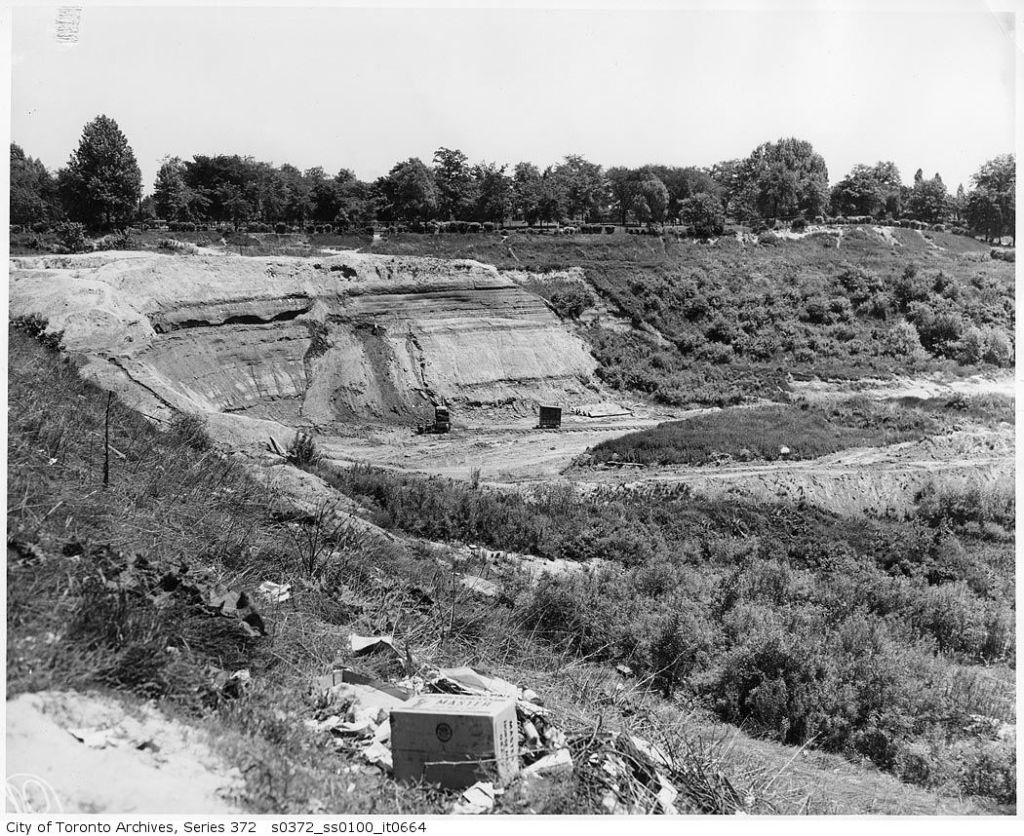
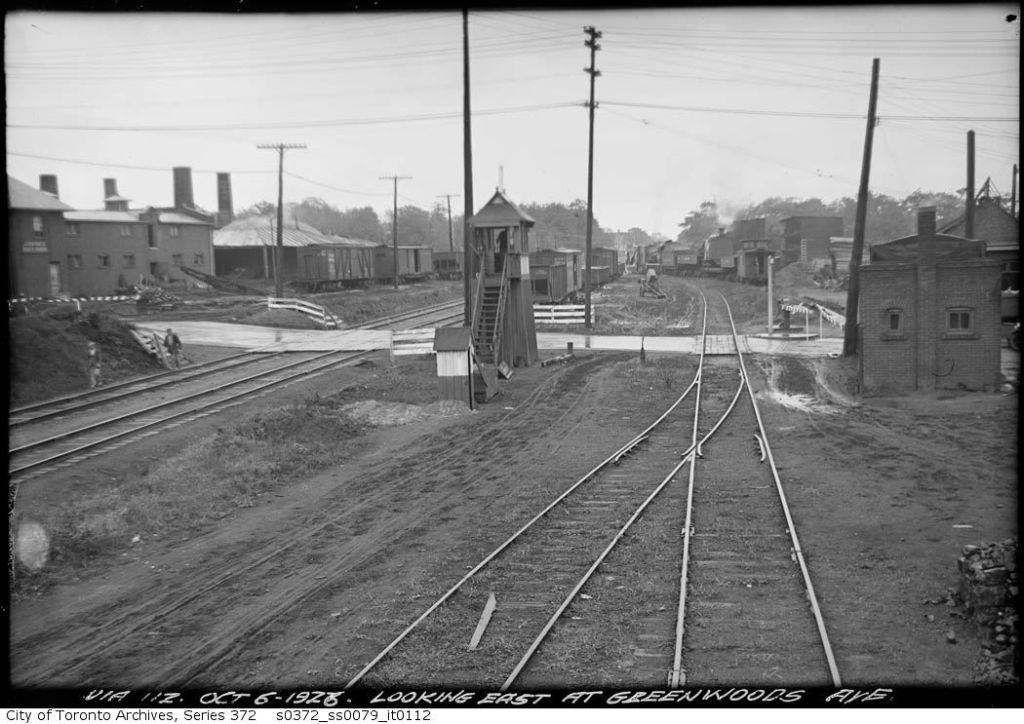
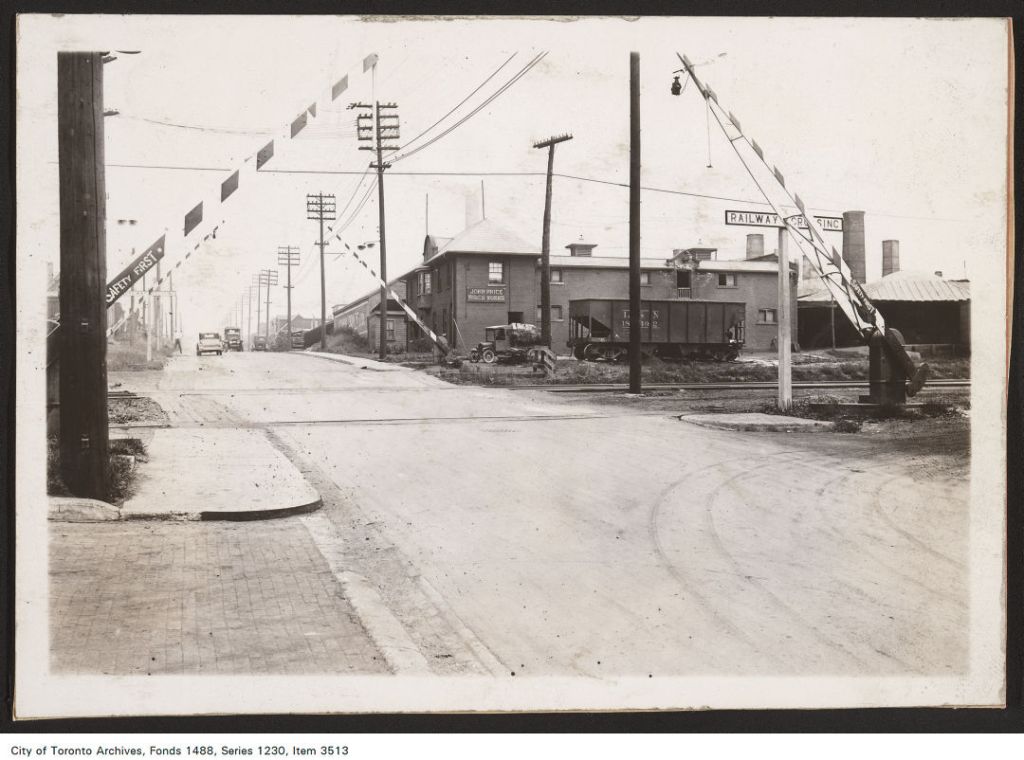


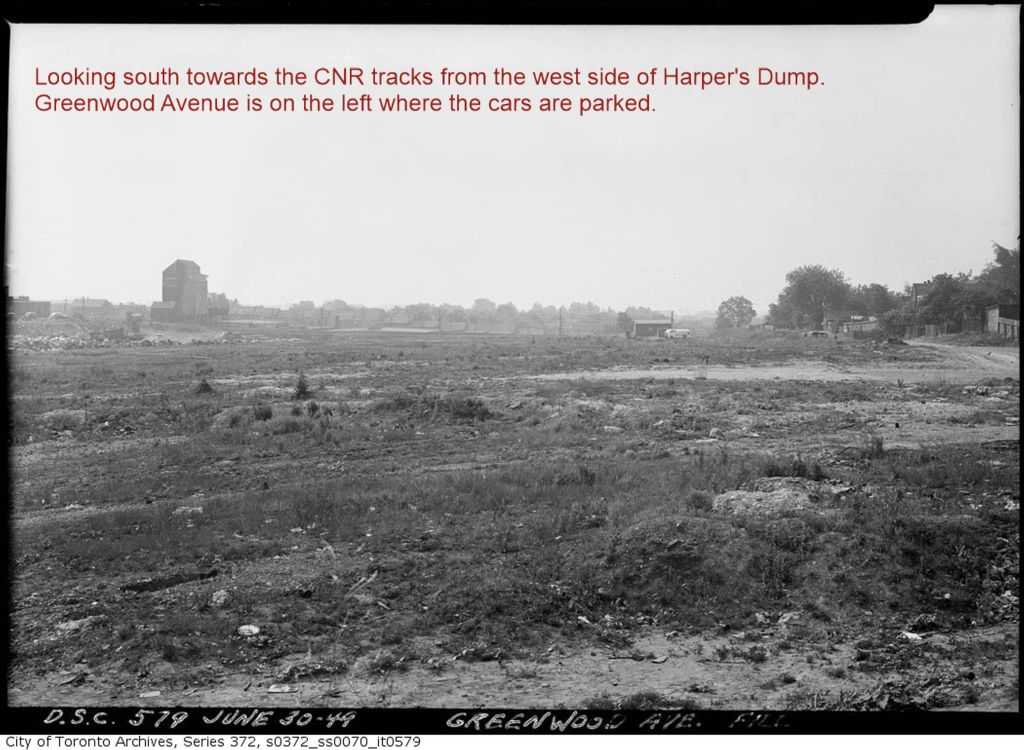
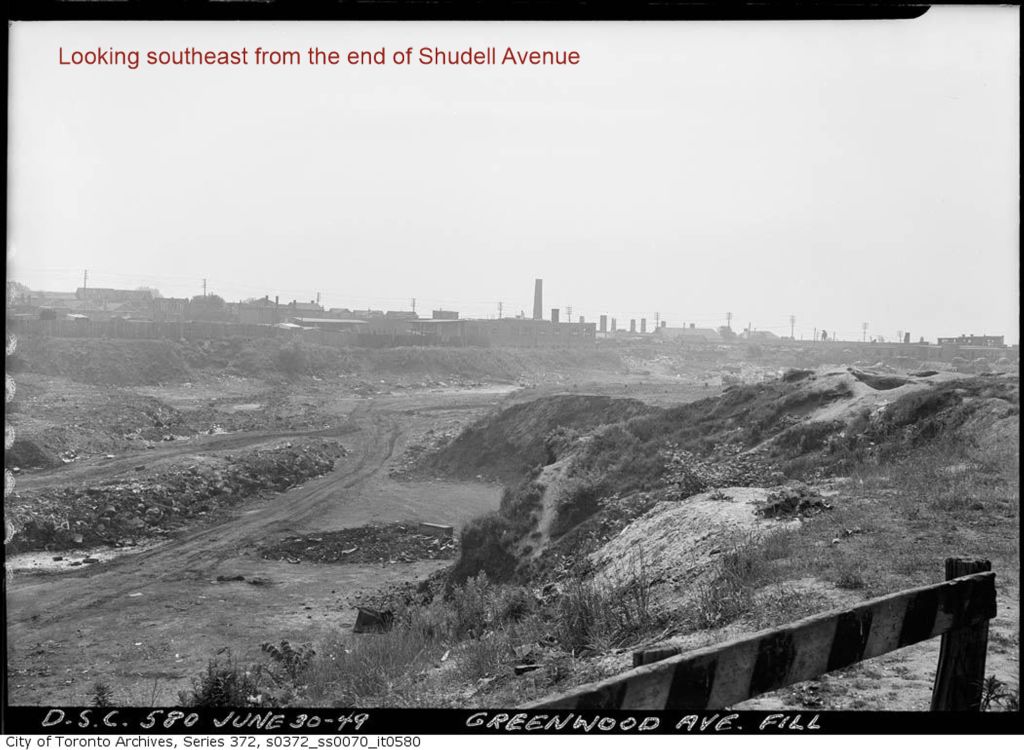


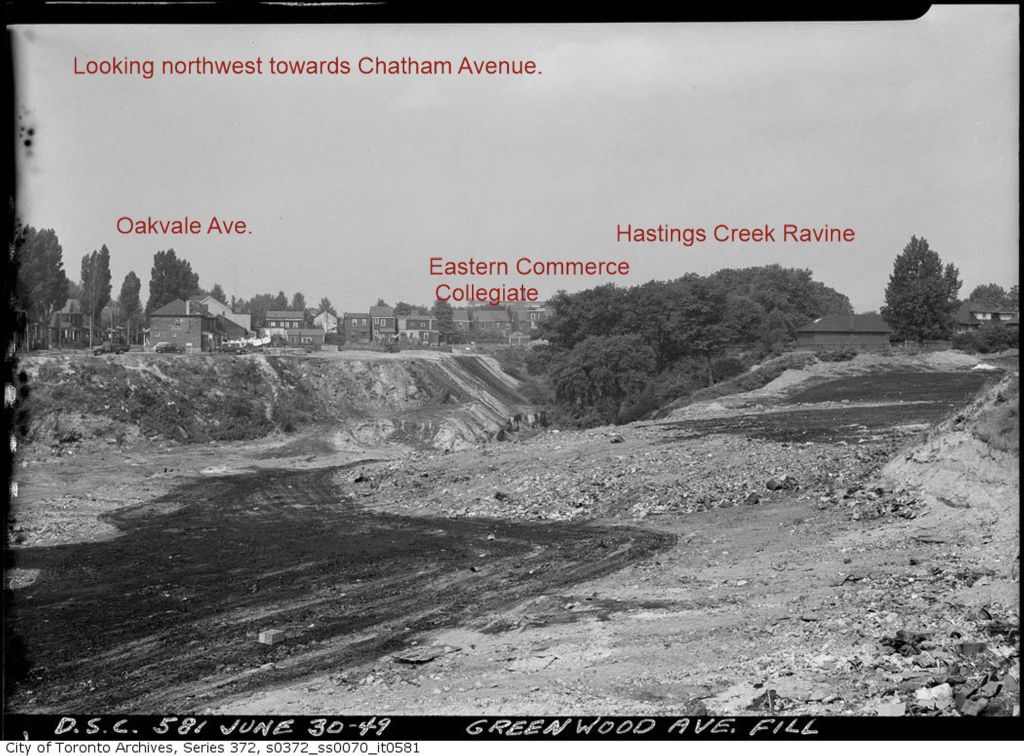


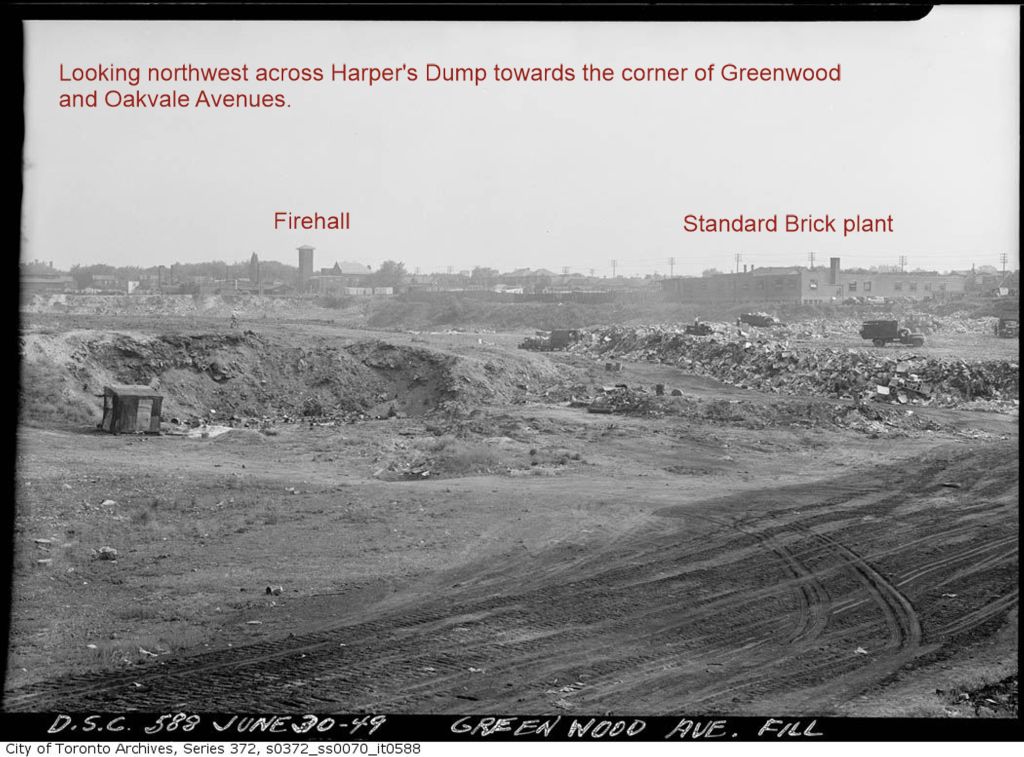

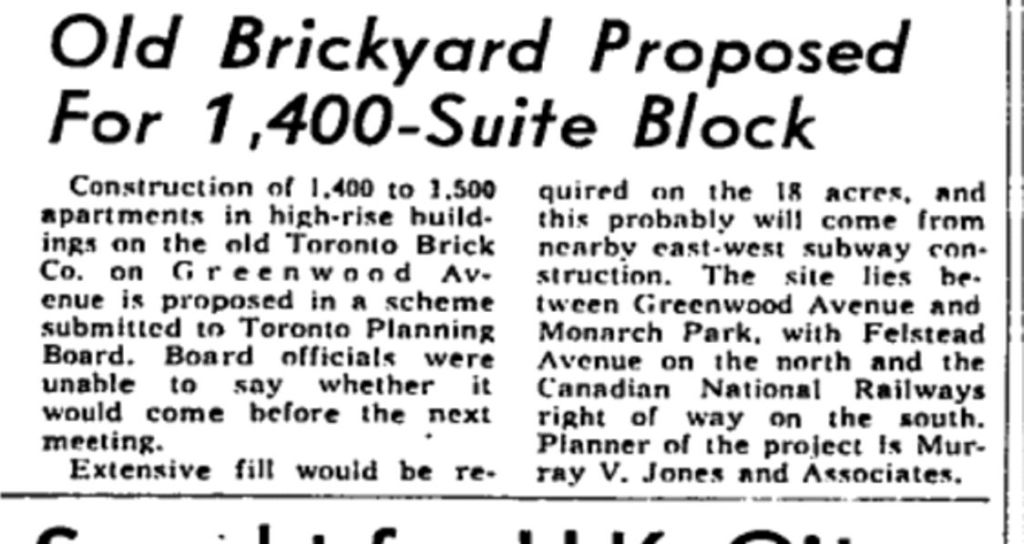
1965 The Toronto Planning Board approved a 1,404-suite apartment and town house complex on the site of an old brickyard on Greenwood avenue. Nine apartment buildings from 9 to 22 storeys and five clusters of townhouses were approved along with a small shopping mall. Torbrick Investments Ltd. were asked to buy up the remaining Greenwood Avenue properties adjoining the site. The Board also wanted some kind of central heating plant to supply heat for all the buildings and thereby reduce pollution. The CN tracks bordered the south end of the site. Therefore, the planners also wanted an earth berm between the tracks and the buildings to reduce noise. The site was a 16-acre brickyard, on the east side of Greenwood Avenue, south of Felstead Avenue.[1] Local residents protested against the proposed apartment and townhouse complex in the old Torbrick yard on the east side of Greenwood Avenue, fearing that the increased demand on local schools and recreational facilities, and the growth in traffic would cause problems. Residents of Felstead and Greenwood Avenues went to the City Building and Development Committee to air their concern. They wanted the developer to provide a pool and rink because local playgrounds were already too crowded. They were also concerned about possible damage to their properties from pile driving, as had happened when the Greenwood subway yards were built.[2] The City of Toronto Board of Control approved zoning changes to allow a high-rise and town house complex in the old Price brickyard at Greenwood and Felstead. The developer had to consider heating all the buildings from one plant; acquire houses on Greenwood Avenue to increase park, and built a pedestrian path to provide access to Monarch Park. 5 per cent of the 18 acre development had to be a park.[3]
[1] Toronto Star August 27, 1965 Friday
[2] Toronto Star Thursday October 14, 1965
[3] Globe Friday August 27, 1965
1845 John Price was born in Somersetshire, England, son of William and Jane (Manchip) Price. His family, like the Morleys, were brickmakers for generations. He learned the business from childhood.[1]
1869 James Price, brick manufacturer, Leslie Street, was English and trained to be a brickmaker there. He came to Canada in 1869.[2]
1869 John Price came to Canada and become a farmer, but it wasn’t long before he became a brickmaker again. His first work as a brickmaker here was for William Plant, whose brickyard was at the foot of Niagara Street near the city’s abattoir. Plant and Price then made sewer pipe for a year, under the name of Plant and Price.
1870 John Price became manager for Lucas Bros., brickmakers, for two years.
1872 John Price went into partnership with John Lucas. The firm of Price and Lucas went on for six years until 1878.
1874 John Price went to visit England and returned with a wife — Jane Powell. They had the following children: George Powell (who married Emma Kerr), Isabella, Albert and Harold; Charles; Harry; Louisa (Lucy); and Susie Jane. The family was Methodist.[3]
1878 The firm of Price and Lucas dissolved. John Price joined with others to found the Price & Co. brick manufacturers on Greenwood Avenue. It grew into one of the biggest in Canada with a reputation for an excellent facing brick: “the John Price”, still in demand today though hard to obtain. Soft-mud “John Price reds” were made by tempering a clay-sand mixture with up to 30 per cent water. John Price used the Martin brick machine which had 20 steel knives on a vertical shaft that pushed the clay down. Wipers mounted on this vertical shaft pressed the clay into a “press box”. A plunger forced the clay into a five-brick mould, filling it completely. Then it was ejected and an empty mould put in the machine. A Martin machine could make up to 3,000 bricks an hour. A filled mold was ejected as an empty freshly sanded mold was inserted. Small amounts of borax, ferro-red or manganese dioxide were added to the sand, as required, to produce the desired colour. The machine could produce up to 3m000 brick per hour, but usually production was in the vicinity of 2400 bricks per hour. John Price bricks, like the other Bricktowne bricks, were made in Ontario Size (2-3/8″h x 4″d x 8-3/8″l), different from brick sizes anywhere else in the world.
The 1878 brickyard employed about eight to ten men and had an output of 10,000 bricks a day. Horses were used to power the equipment. Price enlarged the yard until he turned out 43,000 bricks per day and employed over 40 men.
1884 John Price bought out the other investors and took control of the business.
1885 he employed eight to 10 men and made 800,000 to 900,000 bricks annually.
1916 John Price died May 27, 1916 and is buried in St. James Cemetery.
1928 The Brandon Brick Company of Milton, Ontario, and the John Price Brickyard on Greenwood Avenue amalgamated to form the “Toronto Brick Company”.
1956 United Ceramics Limited of Germany acquired the Toronto Brick Company, closing the Greenwood Avenue brickyard, the Leslieville area’s last brickyard.
1962 The Toronto Brick Company relocated the Parkhill Martin Brick Machine from the former John Price Brickyard to the Don Valley Brickworks to make soft-mud bricks for the “antique” brick market.[4]
[1] Commemorative Biographical Record Of The County Of York Ontario Containing Biographical Sketches Of Prominent And Representative Citizens And Many Of The Early Settled Families Illustrated Toronto :J H. Beers and Co. 1907
[2] History of Toronto and County of York Ontario. Vol. I. Toronto: C. Blackett Robinson, Publisher, 1885, 382.
[3] Commemorative Biographical Record Of The County Of York Ontario Containing Biographical Sketches Of Prominent And Representative Citizens And Many Of The Early Settled Families Illustrated Toronto :J H. Beers and Co. 1907
[4] Baker, M. B. “Clay and the Clay Industry of Ontario”. Report of the Bureau of Mines (Vol. XV, Part II). Toronto: 1906.
Catalogue of Don Valley Products. Toronto: The Don Valley Brick Works Limited, n.d.
Darke, Eleanor. A Mill Shall Be Built Thereon. An Early History of Todmorden Mills. Toronto: Natural History/Natural Heritage, 1995.
Goad’s Fire Insurance Atlas, 1910 and 1910 revised to 1923.
Montgomery, Robert J. “The Ceramic Industry of Ontario”. 39th Report of the Ontario Department of Mines (Vol. 39, Part 4). Toronto: 1930.
“Plant of the Don Valley Brick Works, Toronto”. Canadian Architect and Builder (April 1907).
Sauriol, Charles. Remembering the Don. Scarborough, Ont.: Consolidated Amethyst
Communications, 1981.
Simonton, Jean. “Former Toronto Brick Company, East York.” Typescript. January 28, 1986.
Unterman McPhail Cuming. Don Valley Brick Works: Heritage Documentation and Analysis. Prepared for Metropolitan Toronto and Region Conservation Authority. December 1994.
 The Midway Historical Society of Toronto